TNT SIM Bulk Registration Exemptions? 2026
If you are asking whether there is a TNT SIM bulk registration exemption in 2026, the simple answer is: no blanket exemption. Under the SIM Registration Act, all end-users must register their SIMs, and that includes juridical entities like companies and government agencies. What businesses can get is a special bulk registration process, but that is still registration, not an exemption.
Quick answer
There is no general rule saying businesses, offices, or agencies can skip TNT SIM registration in 2026. Instead, approved companies and government agencies may register certain TNT or Smart prepaid SIMs in bulk under the company or agency’s accountability through an authorized representative. Smart’s own bulk form says it is only for approved juridical entities and only for existing prepaid SIM cards being registered in bulk.You can also read: TNT SIM Legal Requirements Explained 2026
What “bulk registration” really means
Bulk registration does not mean “no registration needed.” It means a company or government entity can register multiple SIMs through a business process instead of having every line handled like a normal individual prepaid registration. Smart’s official form says this is for juridical entities that have requested and have been approved to register their existing prepaid SIM cards in bulk under the entity’s accountability. It also says after-sales transactions are handled through the entity’s authorized signatory only.
So, are there any exemptions at all?
Not the way most people think.
The law says all users must register SIMs. It defines end-users to include both individuals and juridical entities, and it also says all SIMs sold must stay deactivated until registration is completed. I could not find any official 2026 source showing a new blanket exemption for TNT bulk accounts, businesses, or government agencies.
What does exist are special handling rules, such as:
Juridical entities register through an authorized representative
For juridical entities, the law and IRR require entity documents, not just a normal personal ID flow. The IRR says juridical entities must present a certificate of registration and, depending on the entity type, either a board resolution or a special power of attorney designating the authorized representative.
Approved entities may bulk register existing prepaid SIMs
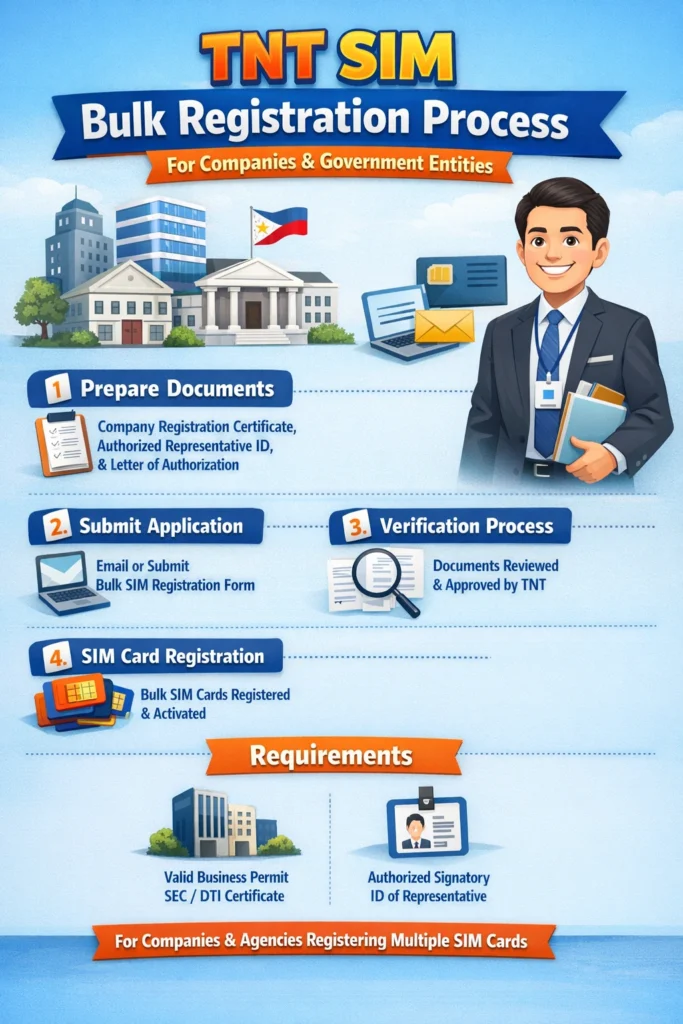
Smart’s bulk prepaid form is specific: it is for approved companies and government agencies registering existing prepaid SIM cards in bulk. That is a workflow advantage, but it is still part of compliance with the SIM Registration Act.
Existing postpaid lines have a lighter path, not a full exemption
The IRR says PTEs shall include the data of existing postpaid subscribers in the SIM register, but those subscribers still need to confirm that their information is true and accurate. Smart’s own registration terms say existing postpaid subscribers are deemed registered only after that confirmation. So this is easier than fresh prepaid registration, but it is not a full exemption either.
Who can use bulk registration?
Based on Smart’s official documents, the bulk route is for juridical entities, which includes companies and government agencies. The form itself says it is for entities that have requested and been approved by Smart to register their existing prepaid SIM cards in bulk. That means not every business automatically gets it just by asking once.
What documents are usually needed?
This is where many competitor articles stay too vague. The official requirements are more specific.
For private companies, Smart’s bulk form lists:
For government entities, the same form lists:
Smart’s registration terms also add more operating details for juridical entity subscribers, such as the authorized signatory’s full name, valid ID, position, contact details, business name, business address, and a list of mobile numbers to be registered under the juridical entity.
Can a company skip individual registration for employee SIMs?
Not fully. A company can use the juridical-entity process for company-accountable SIMs, but that does not erase the registration requirement. It simply changes who registers and how the records are handled. The company’s authorized representative becomes the key contact, and the lines are registered under the entity’s accountability.
What competitor pages usually miss
A lot of general SIM registration articles explain business registration in one short paragraph and stop there. For example, BusinessWorld noted that business enterprises must register and that Smart users need company information and an authorized signatory, but the official Smart forms go further by showing that bulk prepaid registration is limited to approved juridical entities, with specific supporting documents and an entity-accountability setup. That missing detail is exactly where your article can be more useful.
What happens if a business does nothing?
The same rule still applies: unregistered SIMs can be deactivated. TNT’s live SIM registration page says an unregistered SIM can be deactivated, and for new TNT SIMs, users cannot use text, calls, or data until registration is completed. The law also says existing unregistered SIMs were subject to automatic deactivation.
Easy tips for companies and agencies
If you are writing this article for real users, keep these tips in:
Use the word “not exempt” early in the article. That answers the main search intent fast and helps with featured snippets. Official sources support that answer because the law applies to all end-users, including juridical entities.
Tell readers to separate prepaid bulk from postpaid confirmation. These are not the same process. Existing postpaid lines have a confirmation-based path, while approved juridical entities can use a bulk route for existing prepaid lines.
Remind them to prepare the entity papers first. Missing the certificate of registration, board resolution, or authorized representative papers can slow things down. Smart’s own forms make these documents part of the process.
FAQs
Final Words
The best way to explain TNT SIM Bulk Registration Exemptions 2026 is this: bulk registration is a process, not an exemption. If you say that clearly, your article will be more accurate than many thin competitor pages. Companies and government agencies may get a special path for handling multiple lines, but they are still covered by the SIM Registration Act and still need the right papers, the right authorized representative, and Smart’s approval where required.