TNT SIM Legal Requirements Explained 2026
If you want the simple answer, here it is: the legal requirements for TNT SIM registration in 2026 still come from the SIM Registration Act (Republic Act No. 11934) and its Implementing Rules and Regulations. I did not find any new 2026 law that replaces them. TNT’s own page still says new SIMs must be registered before activation, and existing subscribers were required to register under the law.
Quick answer
In 2026, the legal rule is still this: all covered TNT SIMs must be registered, including prepaid, postpaid, eSIMs, data-only SIMs, fixed wireless broadband SIMs, machine-to-machine SIMs, and IoT-related SIMs covered by the IRR. For most users, registration means giving your basic identity details, presenting a valid ID, and submitting the information through the telco’s registration platform. TNT points users to Smart’s official registration channels for this process.You can also read: TNT SIM Auto Deactivation Timeline 2026
Is there a new TNT SIM law in 2026?
No new TNT-specific law appears to have replaced the core rules. The legal basis remains Republic Act No. 11934, approved on October 10, 2022, plus NTC Memorandum Circular No. 001-12-2022, which serves as the IRR. That matters for SEO too, because many “2026” articles sound new but are really just repackaging the same law without saying so clearly.
Who is legally required to register a TNT SIM?
Under the IRR, all end-users are required to register SIMs as a prerequisite to activation. The rules define end-users broadly and cover individuals and juridical entities. The IRR also says the law applies not only to normal mobile SIMs but also to eSIMs, data-only SIMs, fixed wireless broadband, machine-to-machine, and IoT SIMs. TNT’s own registration page also says new buyers must register before activation.
What basic information is legally required?
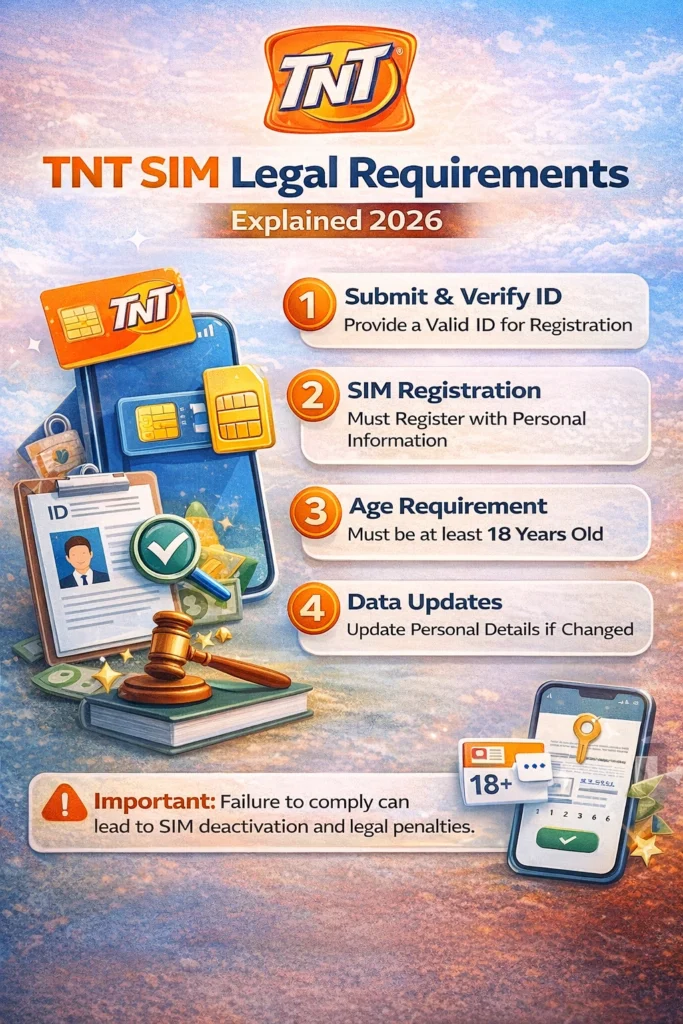
For an individual end-user, the IRR says the SIM register must capture these details: full name, date of birth, sex, present or official address, type of ID presented, and ID number presented. For a juridical entity, the required data includes business name, business address, and full name of the authorized signatory. For a foreign national, the required data includes full name, nationality, date of birth, passport, address in the Philippines, and document details depending on the case.
What valid IDs are accepted?
The law says end-users must present a valid government-issued ID or similar photo document to verify identity. The Act lists examples such as a passport, Philippine ID, SSS ID, GSIS e-Card, driver’s license, NBI clearance, police clearance, and other government-issued IDs. Smart’s own registration guidance also lists a wide range of accepted IDs and says a selfie photo is part of a hassle-free registration process.
Legal requirements for minors
For minors, the SIM is registered under the name of the parent or guardian. The IRR says the registration must include a valid ID from the accepted list plus the consent of the minor’s parent or guardian. This is one detail many thin competitor articles skip or only mention in passing.
Legal requirements for foreigners
For foreign nationals visiting as tourists, the IRR requires all of the following: a passport showing the current 9(a) visa, proof of address in the Philippines, and a return ticket or other ticket showing the date and time of departure. For foreign nationals with other visa types, the IRR requires a passport, proof of address in the Philippines, and another supporting document depending on status, such as an Alien Employment Permit, ACRI Card, or school registration and ID for students.
Legal requirements for companies and other juridical entities
For a juridical entity, the IRR requires a certificate of registration and, depending on the entity, either a board resolution designating the authorized representative or a special power of attorney. Smart’s SIM registration terms also describe juridical entity subscribers as companies, partnerships, sole proprietorships, or government agencies and tie the process to an authorized signatory.
What the telco is legally required to do
The law does not only impose duties on subscribers. The IRR says telcos must maintain a secure SIM register, provide a secure online registration platform, send a notice of successful submission and acceptance on the same day, support changes requested by end-users, and provide help for PWDs, senior citizens, pregnant women, and persons with special needs. The IRR also says SIM registration must be implemented at no cost to end-users.
Is TNT legally required to keep your data private?
Yes. The Act says subscriber data must be secured and protected, and the IRR says information gathered during registration must be treated as absolutely confidential. Disclosure is limited to specific legal situations, such as compliance with law or a court order. The law also sets penalties for breaches of confidentiality.
What happens if you do not comply?
For a new SIM, failure to meet the registration requirements means the SIM is not activated. For the original batch of existing subscribers, failure to register within the legal period resulted in automatic deactivation. TNT’s own page also says failure to comply with the SIM registration terms can result in automatic deactivation.
What happens if you give false information?
This part is serious. The law and IRR impose penalties on anyone who provides false or fictitious information or uses fraudulent identification documents to register a SIM. The IRR states the penalty can include imprisonment from six months to two years, a fine from PHP 100,000 to PHP 300,000, or both. There are also penalties for selling or transferring a registered SIM without following the registration rules.
Why competitor articles still miss the mark
A lot of ranking pages explain TNT SIM registration in very broad terms like “valid ID, selfie, and personal details,” which is useful but incomplete. The official rules are more detailed than that. They split the legal requirements by locals, foreigners, minors, and business entities, and they also spell out privacy, activation, deactivation, and penalty rules. That is the best angle for your article because it gives readers a real legal checklist, not just a generic how-to.
Simple tips for readers
Use only the official Smart/TNT registration channels. TNT’s own page points users to www.smart.com.ph/simreg, Smart Stores, and assisted channels. Save your confirmation details after submission. If you are registering for a minor, a foreign national, or a company, prepare the extra documents first so you do not get stuck halfway.
FAQs
Final Words
The strongest version of this topic is not just “how to register TNT SIM.” It is “what the law actually requires.” That is what helps the page rank for people who want real answers, and it also makes the article more useful for featured snippets and AI overviews: clear definitions, simple language, official-source accuracy, and direct answers high up on the page.